A Factory Price Bath Mat is purchased directly from a manufacturer or wholesale supplier, often at a lower unit cost than retail products. The saving can be attractive, but price alone does not prove value. A mat may look thick in a product photograph, yet feel flat after several washes. That difference matters beside a wet bathtub.
Grand View Research reported that the global home textiles market was valued at approximately USD 133 billion in 2023. Its forecast also indicates continued growth through 2030. Bath mats belong to this broader category, although public reports rarely separate them clearly. This limitation deserves attention. Market figures can guide buyers, but they cannot replace product inspection.
Textile sustainability consultant Debbie McKeegan often emphasizes that material choices should match the product’s real use. Her practical advice can be stated simply: “Design should serve the material, not hide it.” For a Factory Price Bath Mat, that means checking cotton or microfiber composition, backing stability, absorbency, edge stitching, and drying speed. OEKO-TEX STANDARD 100 certification may provide additional reassurance about tested harmful substances, but buyers should verify the certificate number. The U.S. Consumer Product Safety Commission also highlights fall prevention as an important household concern, making grip performance worth testing.
A sensible purchase begins with samples. Rub the surface. Bend the backing. Wash one piece. Compare its weight before and after drying. Even experienced buyers can overlook packaging moisture or inconsistent sizing. Factory pricing is useful, but reliable sourcing requires evidence, not enthusiasm.
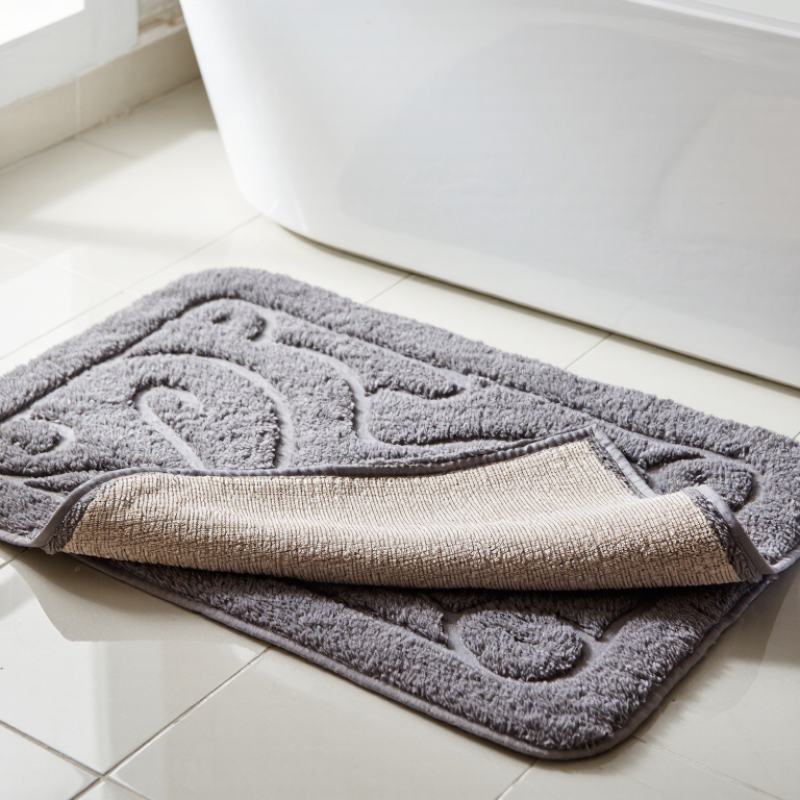
A factory price bath mat is quoted close to production cost, before retail markups and distribution fees. The price depends heavily on fiber, size, construction, and order volume. Cotton feels soft and absorbs water well, while microfiber dries faster and usually costs less. Recycled fibers can reduce material costs, but their softness and color stability need checking.
GSM means grams per square meter.
A 600–900 GSM bath mat usually feels denser and more substantial. However, higher GSM does not automatically mean better performance. A poorly finished 900 GSM mat may hold water and dry slowly. Ask for a sample, then check stitching, backing grip, edge shape, and washing results.
A reliable factory should provide fiber details, GSM tolerance, dimensions, and packing information in writing. Small differences often affect the final cost.
Tips:
Confirm the MOQ before requesting a firm quote. A low unit price may require hundreds or thousands of pieces. Ask whether the MOQ applies per color, size, or total order. Freight can exceed the product cost for bulky cartons, especially by air. Request both sea and air estimates, including carton dimensions, gross weight, customs documents, and delivery terms.
I have seen buyers focus on the unit price and overlook freight. That mistake is common. Compare the landed cost instead.
Also, allow room for sampling and production delays, because factory schedules are not always perfect.
A factory price bath mat is usually quoted directly from a manufacturer, often before shipping, duties, or custom packaging. The price may look attractive, but low cost can hide thinner yarns or loose backing. Ask for the complete quotation.
Factories grade bath mats through several practical checks. Size is measured after production, because washing can cause slight shrinkage. Request the finished size and acceptable tolerance. Absorbency is tested by placing water on the surface and measuring pickup or drying time. Cotton, microfiber, and chenille may perform differently. A mat that feels soft is not always highly absorbent.
Colorfastness checks show whether dye transfers during rubbing, washing, or contact with moisture. Ask for the test method and result, not only “colorfast.” ISO 12947 evaluates abrasion resistance with a Martindale tester. It can indicate how well the surface withstands repeated rubbing. However, a high cycle result does not guarantee strong edging or safe floor grip. Review photos of the hem, backing, and underside. Request a production sample when possible. It may reveal uneven pile or curling corners. I would also confirm washing instructions, test conditions, and batch consistency before accepting a factory price.
| Evaluation Dimension | Typical Factory Specification | Common Grade or Target | How It Is Checked | Why It Matters When Buying |
|---|---|---|---|---|
| Product Type | Tufted cotton, microfiber, chenille, polyester, memory foam, or diatomite-style construction | Select by Use | Review the fiber content, pile construction, backing material, and care label | Material affects softness, drying speed, absorbency, durability, and final factory price |
| Standard Sizes | 40 × 60 cm, 45 × 70 cm, 50 × 80 cm, and 60 × 90 cm | Custom Sizes Available | Measure length and width after production; allow normal textile tolerance of approximately ±2–3% | Correct sizing prevents door interference and improves coverage around the bath, shower, or vanity |
| Weight and Density | Approximately 600–2,000 g/m², depending on material, pile height, and backing | Medium to Heavy | Weigh a conditioned sample and calculate weight per square metre | Higher weight can improve hand feel and coverage, but may increase shipping cost and drying time |
| Absorbency | Common target: 1.5–3.0 times the dry fabric weight for absorbent textile constructions | Fast Water Uptake | Apply a measured amount of water, record uptake and spreading, then check residual moisture after a fixed time | Good absorbency helps keep bathroom floors dry and reduces slipping caused by standing water |
| Drying Performance | Lightweight microfiber generally dries faster than dense cotton or thick memory-foam mats | Quick-Dry Preferred | Measure moisture loss under controlled temperature, humidity, airflow, and time | Faster drying helps reduce odor and is useful for frequently used bathrooms and humid climates |
| Pile Height | Approximately 5–25 mm for textile bath mats; special constructions may be outside this range | Low, Medium, or High | Measure pile height from the backing to the top of the pile at several locations | Low pile improves door clearance, while higher pile can provide a softer and more cushioned feel |
| Colorfastness to Washing | Recommended minimum: Grade 4 on a 1–5 grey scale for routine commercial-quality production | Grade 4 or Better | Wash according to the agreed care procedure and compare color change with a grey scale | Higher colorfastness reduces fading and shade change during repeated laundering |
| Colorfastness to Rubbing | Recommended target: dry rubbing Grade 4 or better; wet rubbing may be lower depending on dye and fiber | Grade 3–4 or Better | Rub a white test cloth against the dry and wet mat surface, then assess transferred color | Helps prevent dye transfer to light-colored floors, socks, towels, or clothing |
| Dimensional Stability | Typical buyer requirement: shrinkage of no more than 3–5% after the agreed washing cycle | Within Tolerance | Measure length and width before and after washing, drying, and conditioning | Controls curling, size loss, and poor fit after the first few washes |
| Abrasion Resistance | Tested using the Martindale method under ISO 12947; required cycles should match the intended use | Specify the Cycle Target | Expose the surface to controlled rubbing and record appearance change, yarn breakage, or end point | Higher resistance is valuable for hotels, rental properties, and bathrooms with frequent foot traffic |
| Suggested ISO 12947 Targets | Residential: around 10,000–20,000 cycles; commercial use: commonly 20,000 cycles or more | Use-Dependent | Confirm the test pressure, abradant, end point, and reporting method with the factory or laboratory | A cycle number is meaningful only when the complete test conditions and failure criteria are stated |
| Backing and Slip Resistance | TPR, PVC, latex, silicone, or non-slip printed backing; backing should remain flexible after washing | Stable and Non-Slip | Inspect coating coverage, flex the backing, and perform a slip test on a clean, dry floor surface | Reduces movement during use, although no bath mat should be treated as a complete substitute for safe flooring |
| Edge and Stitch Quality | Even overlock stitching, secure binding, no open seams, loose yarns, or exposed backing at the edge | Clean Finish | Perform visual inspection and manually check corners, seams, and attachment points | Strong edges reduce fraying, shape distortion, and customer complaints |
| Odor and Chemical Compliance | Low-odor production with material and finishing chemicals suitable for the destination market | Request Test Reports | Review applicable restricted-substance, formaldehyde, azo-dye, and heavy-metal documentation | Requirements vary by country; written compliance documents should be agreed before bulk production |
| Factory Price Factors | Material cost, size, weight, construction, backing, color count, packaging, order quantity, and customization | Quote by Specification | Request a quotation based on one written specification rather than a product photo alone | Comparable specifications make it easier to identify whether a low price reflects lower quality or efficient production |
| Minimum Order Quantity | Often lower for stock colors and standard sizes; custom colors, labels, packaging, and molds may require higher quantities | Confirm Before Sampling | Ask for MOQ by size, color, design, and packaging configuration | MOQ affects inventory risk, unit price, sampling cost, and the feasibility of a private-label order |
| Pre-Production Approval | Approved sample, color standard, dimensions, weight, backing, packaging, and inspection criteria | Required Before Bulk Order | Sign off on a sealed reference sample and written specification sheet | Creates an objective reference for production inspection and reduces disputes over acceptable quality |
A factory price bath mat usually comes directly from a manufacturer or wholesale supplier. The lower cost may reflect bulk production, simpler packaging, or fewer retail layers. Still, price should not replace safety checks. Ask for the material details, production photos, and a current test report before ordering.
Look for OEKO-TEX Standard 100 certification that matches the exact product, not only the factory. Check the certificate number, product class, and validity date. A supplier should explain which parts were tested, including fibers, dyes, and backing. I have seen listings use safety language without showing verifiable documents. That is a warning sign.
Inspect the latex backing carefully. It should cover the underside evenly, without brittle patches, strong chemical odor, or visible peeling. People with latex sensitivity need another backing material. Test slip resistance on wet ceramic tile, not only on a dry showroom floor. Press down with your foot and move slowly. The mat should stay flat, and its edges should not curl. Even a good backing can fail on dusty, soapy, or uneven floors. That detail is easy to miss. Ask whether washing changes the backing, because repeated heat and moisture may reduce grip. A small sample can reveal loose fibers, fading, or poor recovery after compression. I would rather delay a purchase than trust a polished product photo.
A factory price bath mat is priced close to production cost, before retail margins and distribution fees. The lower price can be attractive, but supplier comparison requires evidence, not promises. Request a physical sample before discussing bulk orders.
Check the mat’s dimensions, fabric weight, absorbency, edge stitching, backing grip, and colorfastness. Place it on a smooth floor and test it after washing. A sample may look excellent while hiding weak backing or uneven seams. That assumption is risky. Ask whether the sample matches the proposed bulk material and packaging.
For bulk inspection, define AQL 2.5 clearly in the purchase agreement. AQL 2.5 is an acceptance sampling level, not a guarantee that every mat is perfect. Specify critical, major, and minor defects, then use an independent inspection before shipment. Compare the full lead time, including sampling, approval, production, inspection, and loading. “Twenty days” may exclude fabric preparation. Clarify it.
Incoterms also change the real factory price. Under FOB, the seller generally handles export clearance and delivery to the named port, while the buyer manages the main transport. FCA may suit container or inland collection better. DDP appears convenient, but confirm taxes, delivery responsibility, and import compliance in writing. Ask for a dated quotation with currency, carton details, payment terms, and validity. Small omissions often become expensive corrections.
Compare anonymous supplier options by sample turnaround, production lead time, and AQL 2.5 inspection scheduling before confirming an Incoterm.
Use AQL 2.5 as a consistent lot-quality benchmark and confirm the inspection plan before shipment.
Add sample approval time, production time, inspection time, and transport time to estimate the total schedule.
Compare EXW, FOB, and DDP only after confirming which party pays freight, insurance, customs, and delivery charges.
The figures are practical planning references for a standard bath mat order, not claims from any named company. Request physical samples, confirm the AQL 2.5 inspection method, and obtain a written lead-time and Incoterm quotation before placing an order.
A factory price bath mat is purchased directly from a manufacturer, often before retail markups. The lower quote does not always mean lower total cost. Confirm the exact specifications first. Ask for fiber type, dimensions, weight, backing material, absorbency, color, edge stitching, and packaging. A 50 × 80 cm mat may look standard, but small size differences can affect production and carton loading. Request a sample when possible. Touch it, wash it, and check whether the backing curls or smells strongly after drying.
The usual minimum order is 500 units. Confirm whether this quantity applies to one color, one size, or the full order. Mixed colors may require separate production limits. Clarify the payment schedule in writing, including the deposit, balance, and inspection conditions. A proforma invoice should list unit price, tooling, packaging, and any sample charges. Avoid relying on informal messages alone. Details disappear.
Shipping also needs careful checking. Ask for carton dimensions, gross weight, production time, loading port, and estimated transit time. Confirm who handles export documents, insurance, and destination charges. Compare the factory quote with freight and import costs. I once underestimated carton volume, and the shipping difference weakened the expected savings. Allow time for inspection and possible rework. Cheap is useful only when the delivered product remains consistent.
It usually means a price near production cost. Retail margins and distribution fees are excluded. The final cost may still rise after freight, inspection, and import charges.
No. A 600–900 GSM mat feels denser, but it may dry slowly. A poorly finished thick mat can hold water. Check absorbency, stitching, backing grip, and drying time.
Measure the mat carefully. Check fiber feel, fabric weight, edge stitching, and backing grip. Wash it once. Notice curling, loose seams, strong smells, or color changes.
Cotton feels soft and absorbs water well. Microfiber usually dries faster and costs less. Recycled fibers may reduce costs. Check their softness and color stability before ordering.
The quantity may apply to one color, one size, or the full order. Confirm this in writing. Mixed colors can require separate production limits. Details disappear.
Request fiber type, dimensions, GSM tolerance, packaging, currency, and price validity. Include sample charges and tooling costs. A written quotation prevents expensive misunderstandings.
Request sea and air estimates. Include carton dimensions, gross weight, loading port, and transit time. Air freight can exceed the product cost for bulky cartons. Compare landed cost, not unit price.
AQL 2.5 is an acceptance sampling level. It does not mean every mat will be perfect. Define critical, major, and minor defects clearly. Use an independent inspection before shipment.
Different terms divide transport, export clearance, insurance, and destination charges differently. Confirm responsibilities in writing. A convenient quote may hide extra costs. This estimate can still be wrong.
Count sampling, approval, fabric preparation, production, inspection, loading, and transit. A quoted twenty-day schedule may exclude preparation. Allow time for rework. Cheap is not enough.
A Factory Price Bath Mat is purchased directly from a manufacturer, helping reduce added distribution costs. However, the final price depends on fiber type, fabric weight, typically measured in GSM, order quantity, packaging, and freight expenses. Buyers should compare essential specifications such as size, absorbency, colorfastness, and durability. Testing based on ISO 12947 can also help evaluate resistance to rubbing and everyday wear.
Before ordering, request samples to check softness, stitching, backing quality, and actual performance. Safety should be verified through OEKO-TEX Standard 100 certification, latex backing information, and slip-resistance testing where appropriate. When comparing suppliers, review their inspection procedures, including an AQL 2.5 standard, production lead time, and applicable Incoterms. A typical order may require a 500-unit minimum quantity. Confirm all specifications in writing, agree on payment terms, approve a pre-production sample, and clarify shipping arrangements, carton details, and responsibility for freight before placing the final order.
Yide Plastic